AI strategy
How to use EU and Greek funding to pay for your first AI project
By Othon Tzobras

Most small companies approach AI funding backwards. They find a grant, then look for something to spend it on. The result is often a rushed application, a budget built around what the call allows rather than what the business needs, and a project that stalls once the money is spent.
A better order: pick one valuable use case, test it cheaply, then fund the rollout from the source that fits. In Greece in late 2026 that source is often not a single big grant. It is a mix of free EU-funded support, a regional or national call when one is open, and sometimes a subsidised loan.
This guide shows how to put that mix together, and the rules that trip companies up. Programme details are as of October 2026; check the official calls before you apply. For a full list of programmes and their status, see our companion guide, AI funding for Greek SMEs in 2026.
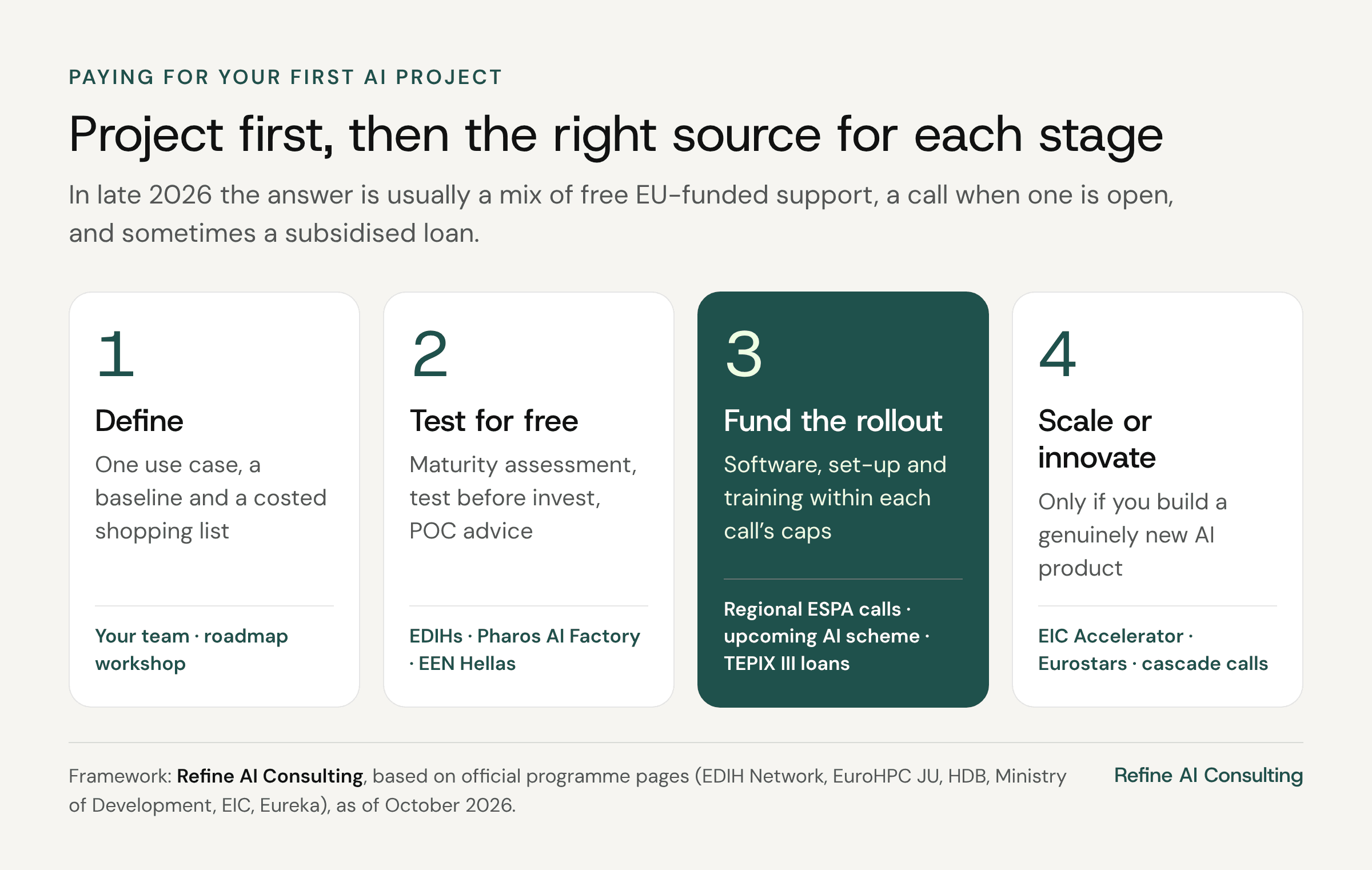
Step 1: Start with a project, not a programme
Funding bodies, banks and EU hubs all ask the same questions:
What problem are you solving?
What will you buy?
What will change?
Before you look at any call, write a one-page project brief. It should cover:
The use case: one process, such as handling customer emails, preparing quotes or reconciling invoices. Our guide to choosing your first AI use case walks through the selection.
The baseline: how long the process takes today, what it costs and what errors it produces.
The shopping list: software licences or subscriptions, integration and set-up work, training, and any hardware.
The expected result: hours saved, faster response, fewer errors. See how to measure ROI on an AI project.
Split the shopping list by cost type, because that is how calls cap spending. A brief like this takes a week. Without one, no programme will help much.
Step 2: Use free support to de-risk the idea
Before spending your own money or a grant’s, use the support that costs you nothing.
European Digital Innovation Hubs
Greece’s seven EDIHs are co-funded by the EU’s Digital Europe Programme and ESPA. They offer a digital maturity assessment, a tailored plan and “test before invest” services: demonstrations, testbeds and pilots.
Smart Attica focuses on AI and also helps companies find investment. According to the EDIH FAQ (April 2026), services are free or below market price. The discount is recorded as state aid, usually de minimis.
The Pharos AI Factory
Pharos, Greece’s EuroHPC AI Factory, offers SMEs AI tools, datasets, pre-trained models, training and consultation on proofs of concept. GRNET ran free one-to-one sessions for SMEs in September and October 2026. Watch pharosfactory.ai for its SME programme and open calls.
Enterprise Europe Network
EEN Hellas gives free advice on innovation, digitalisation and EU funding through 16 partner organisations across Greece.
Use this phase to answer one question: does the use case work on your data, with your people? A small pilot is worth more to any later application than a polished business plan. See how to run an AI pilot in 90 days.
Step 3: Match the rollout to the right funding source
A grant call, when one is open
The ESPA “Digital Transformation of SMEs” actions and the Recovery Fund “Digital Tools” vouchers have closed. The Ministry of Development says a Development Law scheme for SMEs on modern technologies, with an emphasis on AI, will open by the end of 2026. It was announced in February 2026 at €150 million, with training and consultants among its aims. Its rules are not published yet.
Regional ESPA programmes also publish investment calls that accept software. In October 2026, calls in Central Greece and the South Aegean were open until 30 October.
A subsidised loan
If no suitable call is open, the Hellenic Development Bank’s TEPIX III loans offer:
40% of the loan interest-free;
an interest subsidy of up to 3% for the first two years;
guarantees of up to 80%.
Investment loans start at €20,000. You apply through a partner bank. Confirm with the bank that your AI costs count as investment.
EU innovation funding, only if you are building something new
The EIC Accelerator, Eurostars and most Horizon Europe calls fund innovation and R&D. They don’t fund adopting existing tools. If your “AI project” means using proven software better, these are the wrong fit.
Step 4: Know what a typical call will and won’t pay for
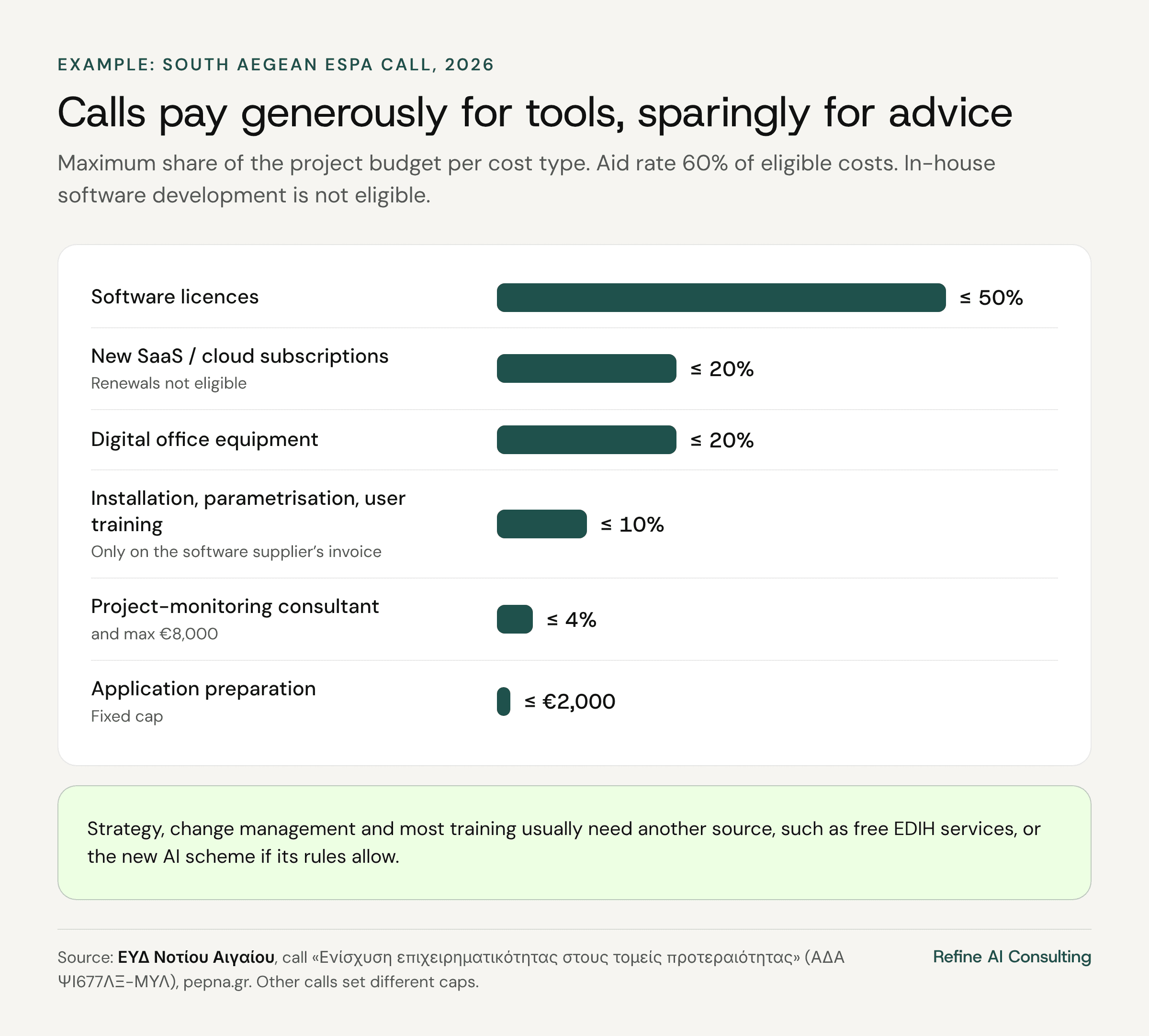
Every call has its own rules, but the 2026 South Aegean call is a useful example of the pattern. Its official text allows:
Software licences: up to 50% of the budget.
New cloud or SaaS subscriptions: up to 20%. Renewals are not eligible.
Installation, parametrisation and user training: up to 10%, but only when included in the software supplier’s invoice.
Consulting for monitoring the project: up to 4% and no more than €8,000.
Preparing the application: up to €2,000.
Not eligible: software you develop in-house.
The ESPA Basic Digital Transformation call followed similar logic. It allowed external consulting for monitoring implementation, and technical support for installing and parametrising systems, each within set percentages.
The lesson: calls fund things and set-up generously, and advice sparingly. Strategy work, change management and much of the training usually need another source. That could be free EDIH services, or the new AI scheme if its rules allow it.
The rules that catch companies out
Starting too early. Each call sets an eligibility start date. Orders and invoices dated before it are not funded.
Double funding. The same cost cannot be paid twice. EDIH rules specifically forbid using vouchers to top up EDIH services.
The de minimis ceiling. Most SME aid counts toward a limit of €300,000 per company over three years, including discounted EDIH services. Keep a running record.
Payment trail. Calls require payment by bank transfer from the company account to the supplier’s business account, never through shareholders’ personal accounts.
Contracts. Consulting must be specific, non-routine and under a written contract. Some calls also require it to be filed with the tax office.
Linked suppliers. Buying from a company you or your partners own is risky. Check each call’s rules.
Data protection. A funded tool still has to meet GDPR and the AI Act. Build compliance into the plan from day one.
Frequently asked questions
Should we wait for the new AI scheme before starting anything?
Don’t wait idle. Use the time for the steps that are free or cheap and that any application will need: the brief, a maturity assessment and a pilot. Avoid ordering the main rollout until you know the call’s eligibility start date.
Can a consultant prepare our application?
Yes. Application preparation is a recognised cost in many calls, usually with a low cap. You remain responsible for the declarations you sign, such as company size, linked enterprises and previous state aid.
Will a grant cover the whole project?
No. Grants cover a percentage, for example 60% in the South Aegean call. You pay the full invoices first and are reimbursed after checks. Plan for cash flow, which is where a TEPIX III loan can help.
Is free EDIH support really free?
It costs you no fee, or a reduced one, but the value of the discount is recorded as state aid. That matters if you are near your de minimis limit.
Want a funding-ready AI plan? Our AI roadmap workshop turns one use case into a costed brief you can take to an EDIH, a bank or the next call. See how we take projects from plan to rollout on our AI consulting for SMEs page.
Free download
The AI Readiness Checklist
25 questions to find out whether your business is ready for AI — and what to fix first. Enter your email and download the PDF instantly.
Want an AI roadmap like this for your business?
In a two-day workshop, we turn your team’s ideas into a prioritized AI plan you can start executing within 90 days.
